
Here is an uncomfortable truth: roughly a third of the average cloud bill pays for resources nobody is actually using. Meanwhile, AI workloads have pushed cloud spending to record levels, and the FinOps Foundation now treats AI as its own cost domain — one with unpredictable spend, granular token-based billing, and expensive GPU capacity that racks up charges even while sitting idle. In an earlier post we explored how AI-powered cloud infrastructure can automate parts of this problem. However, tools alone do not fix overspending — process does. Cloud cost optimization is the discipline that makes the tools pay off, and this guide covers the seven strategies that deliver the biggest savings in 2026.
Why Cloud Cost Optimization Is Different in 2026
For a decade, cloud cost optimization meant trimming idle virtual machines and buying reserved instances. Those tactics still matter — however, the game has changed in three important ways. First, AI is now a major line item: enterprise AI usage has scaled so fast that even with plummeting per-unit inference costs, total AI bills keep climbing. Second, traditional FinOps assumptions break under AI workloads; steady GPU pipelines and continuous inference do not behave like the elastic, bursty workloads cost tools were designed for. Third, cloud providers themselves face rising energy and hardware costs, which means the era of automatic annual price cuts is over.
Meanwhile, industry research confirms that FinOps in 2026 is no longer a “good to have” — it is the foundation of every serious cloud strategy, ensuring each dollar spent delivers measurable value. In short, cloud cost optimization is now a continuous engineering practice, not a finance spreadsheet exercise.
The FinOps Loop: Visibility, Accountability, Optimization
Every effective cloud cost optimization program rests on the same three-phase loop. Visibility means seeing every resource and its cost, tagged by team, project, and environment — you cannot optimize what you cannot attribute. Accountability means engineers who provision resources also see (and own) their costs. Optimization means acting on that data continuously: rightsizing, rearchitecting, and renegotiating. Flexera’s FinOps guidance emphasizes that these same principles now extend to AI resources, where every new training run can lead to a breakthrough — or an expensive rabbit hole.
Seven Proven Cloud Cost Optimization Strategies
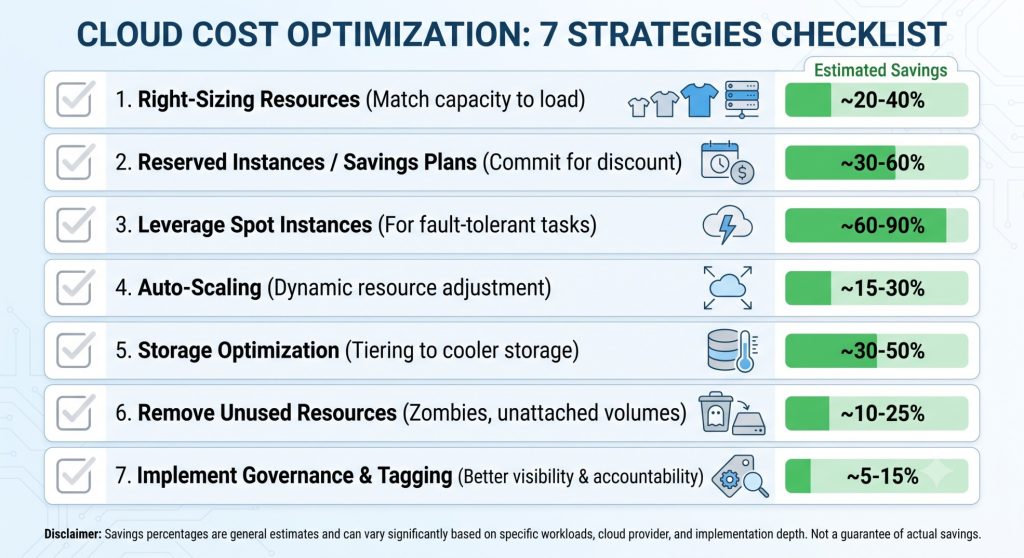
- Rightsize relentlessly. Most instances are provisioned for a peak load that rarely arrives. Continuous rightsizing on AWS and Azure is consistently the single largest source of recovered compute spend.
- Commit strategically. Reserved instances and savings plans offer discounts of up to 72% over on-demand pricing — but only for stable baseline workloads. Commit to the floor, not the ceiling.
- Schedule and autoscale. Development and staging environments running nights and weekends are pure waste. Automated start/stop schedules through your DevOps pipelines are the easiest savings you will ever find.
- Tier your storage. Move infrequently accessed data to colder storage classes and set lifecycle policies. Storage grows silently until it does not.
- Tag everything, allocate everything. Untagged resources are unaccountable resources. Enforce tagging at provisioning time so every dollar maps to a team and product.
- Watch egress and architecture. Data transfer fees and chatty cross-region architectures quietly inflate bills. Sometimes the cheapest optimization is an architectural review of your virtual server layout.
7. Reconsider where workloads live. Not everything belongs in public cloud. Stable, predictable workloads often run 40–60% cheaper on a well-managed OpenStack private cloud — a route many businesses are taking as they exit costly VMware licensing. A hybrid model gives you the control of private infrastructure with the elasticity of public cloud.
Don’t Forget Your AI Spend
If your business runs AI workloads — chatbots, recommendation engines, LLM-powered features — apply the same discipline there. Track cost per token and cost per inference, not just monthly totals. Shut down idle GPU capacity automatically; accelerated instances are premium-priced whether they are working or not. Additionally, match model size to the job: a smaller, cheaper model that meets your quality bar beats a frontier model used out of habit. These practices, formalized in the FinOps Foundation’s FinOps for AI framework, are quickly becoming standard for any organization serious about cloud cost optimization.
How VIPoint Helps You Spend Smarter
Cloud cost optimization is one of the most requested outcomes from our clients — and one of the most measurable. Our certified engineers run structured cost audits across AWS and Azure estates, then implement the fixes: rightsizing, scheduling, storage lifecycle policies, and commitment planning. For businesses ready to go hybrid, we design and operate OpenStack private clouds and manage the full data center stack with 24/7 server management from our Infopark, Kochi operations center. Because our team covers US business hours and overnight windows natively, optimization is continuous — not a one-time report that gathers dust. And with round-the-clock helpdesk support, cost savings never come at the expense of response times.

The Bottom Line
In 2026, the winners are not the companies that spend the most on cloud — they are the ones that spend the smartest. A disciplined, continuous approach to cloud cost optimization pays for itself many times over, and it pairs naturally with sustainable, energy-efficient IT practices that cut costs from the other direction. Ultimately, every month you delay is a month of waste you never get back.
Want to know exactly where your budget is leaking? Contact VIPoint Solutions for a FinOps cost audit — we will map your spend, flag the waste, and hand you a prioritized savings plan within one week.