
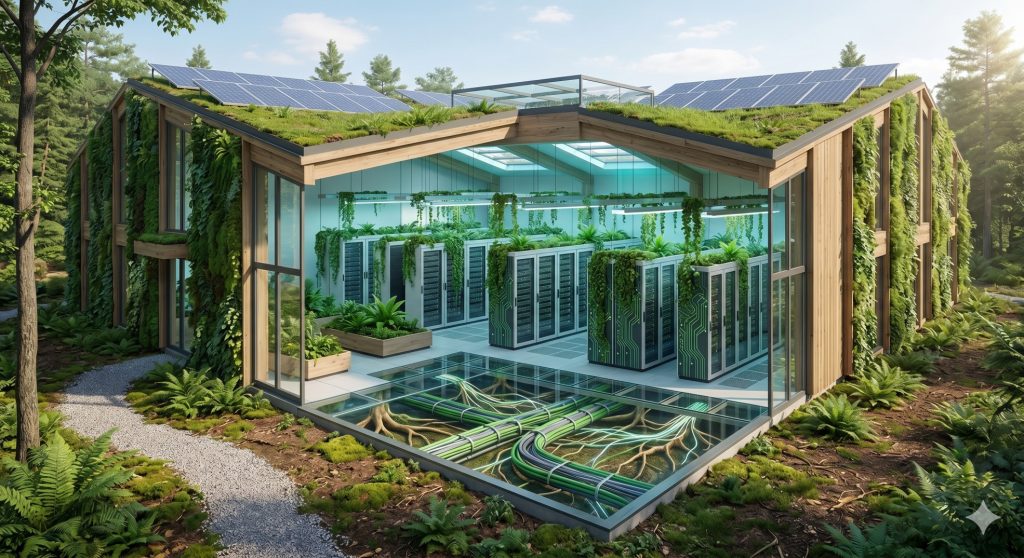
Green computing for business is no longer just an environmental talking point — it is a proven strategy for reducing IT costs, improving performance, and meeting growing compliance requirements in 2026. The massive energy demands of data centers, cloud services, and AI workloads have pushed the global technology industry into what experts call a “carbon reckoning.” However, forward-thinking companies are turning this challenge into a competitive advantage. Furthermore, Gartner has identified sustainable technology as a top strategic trend for 2026, emphasizing that businesses must measure and reduce their IT environmental impact. The good news? Green computing for business saves money and improves efficiency at the same time.
What Is Green Computing for Business and Why Does It Matter Now?
Green computing for business encompasses every practice that reduces the environmental impact of your IT operations while maintaining or improving performance. This includes energy-efficient server management, cloud resource optimization, hardware lifecycle management, and sustainable software development practices.
Specifically, data centers currently consume approximately 1–2% of global electricity, and this figure is rising sharply as AI workloads explode. In addition, a single poorly optimized server can waste thousands of rupees in electricity annually while delivering a fraction of its capacity. Consequently, businesses that ignore green computing are not just harming the environment — they are burning money.
Moreover, environmental, social, and governance (ESG) requirements are tightening globally. Many enterprise clients now require their vendors and partners to demonstrate sustainable IT practices. According to Wavestone’s Technology Trends 2026 report, ESG data governance has become a critical priority, with organizations needing to accurately measure and report their technology’s environmental footprint.
How Green Computing for Business Reduces IT Costs
The most compelling argument for green computing is financial. Sustainable IT practices directly translate to lower operating costs. Here are the areas where businesses see the most significant savings:
- Server Consolidation and Virtualization: Running 10 physical servers at 15% utilization wastes enormous energy. Consolidating them into 2–3 optimized virtual servers saves 60–75% in power consumption. Our virtual server management team specializes in exactly this type of optimization.
- Cloud Right-Sizing: Most businesses over-provision cloud resources by 25–35%. Identifying and eliminating idle instances, oversized volumes, and unused snapshots immediately reduces both costs and energy consumption.
- Efficient Code and Architecture: Well-optimized applications consume fewer compute resources. Refactoring bloated code and adopting efficient architectures reduces the hardware needed to serve the same workload.
- Automated Power Management: Development and staging servers do not need to run 24/7. Automated scheduling that powers down non-production environments during off-hours saves 30–50% in compute costs.
- Hardware Lifecycle Optimization: Extending server hardware life through proper maintenance, firmware updates, and proactive monitoring reduces both electronic waste and capital expenditure.
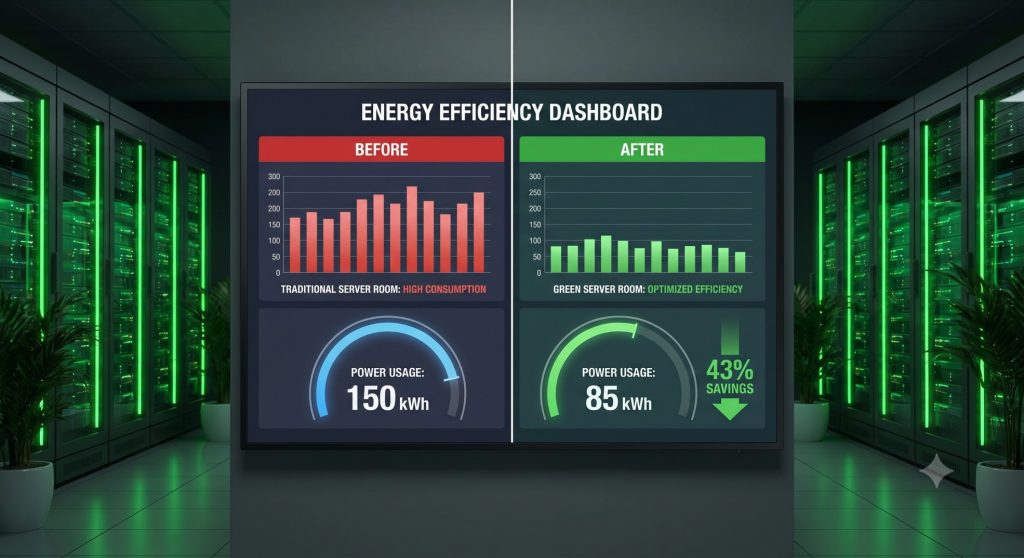
As a result, businesses that implement these practices typically reduce their IT energy costs by 30–50%. At VIPoint Solutions, our server management services include energy optimization as a standard part of our management framework.
Green Computing for Business in the Cloud: AWS, Azure, and Beyond
Cloud providers are investing heavily in sustainability tools, making green computing for business easier than ever to implement. Nevertheless, simply moving to the cloud does not automatically make your IT green. You need a deliberate strategy.
For instance, AWS offers a Carbon Footprint Tool that tracks emissions across your account. Similarly, Azure provides a Sustainability Dashboard that measures your environmental impact by resource and region. In both cases, choosing the right region can significantly reduce your carbon footprint because some data centers run entirely on renewable energy.
In addition, containerization through Docker and Kubernetes dramatically improves resource utilization. Containers share the host operating system kernel, eliminating the overhead of running separate virtual machines for each application. Consequently, you serve the same workload with fewer compute resources and less energy.
Our AWS managed services and Azure management team help businesses optimize their cloud environments for both performance and sustainability. Meanwhile, our DevOps services implement container-based architectures that maximize resource efficiency. According to the International Banker’s 2026 Technology Outlook, the massive energy demands of data centers are forcing a radical shift towards sustainable-by-design IT.
Implementing Green Computing for Business: A Practical Action Plan
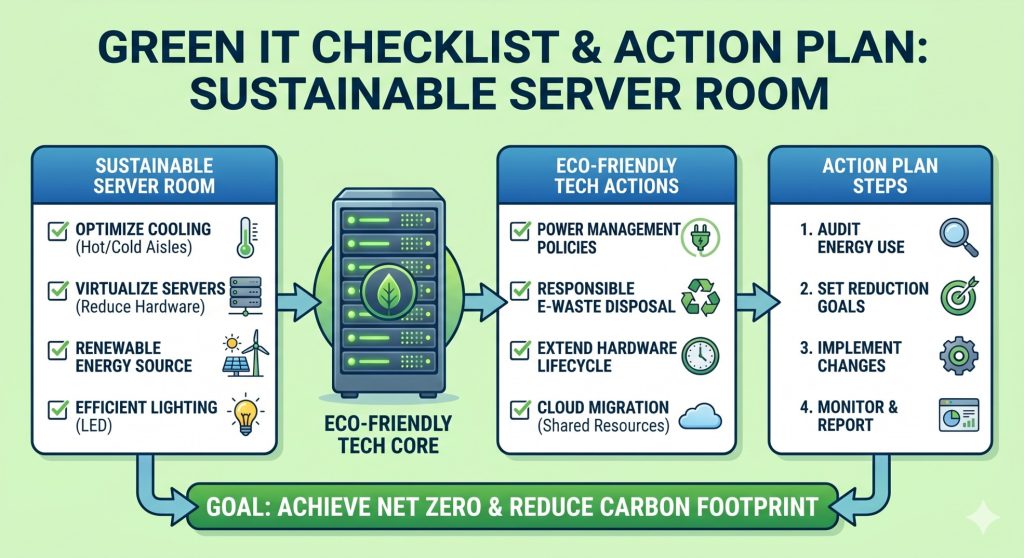
Getting started with green computing does not require massive investment. On the contrary, most sustainability improvements pay for themselves within months through reduced energy and infrastructure costs. Here is a practical action plan.
To begin, measure your current IT energy consumption. You cannot optimize what you do not measure. Document the power usage of your servers, network equipment, and cooling systems. Similarly, pull usage reports from your cloud providers to identify waste.
Next, implement quick wins. Shut down idle development servers. Remove orphaned cloud resources. Right-size oversized instances. These actions require minimal effort but deliver immediate results. Our cPanel server management team regularly identifies and eliminates these types of waste for hosting clients.
Then, consolidate and virtualize your physical infrastructure. Fewer physical servers means less power, less cooling, and less maintenance. Our VMware virtualization experts and OpenStack team design consolidation strategies that maximize performance while minimizing energy footprint.
Finally, build sustainability into your development and deployment processes. Integrate energy-aware practices into your CI/CD pipeline. Choose efficient programming languages and frameworks. Optimize database queries and caching strategies. According to Gartner’s Top Technology Trends for 2026, sustainable technology is a strategic imperative that CIOs must act on now.
Why VIPoint Solutions Champions Green Computing for Business
At VIPoint Solutions, we believe that sustainable IT and excellent performance go hand in hand. Our approach to server management has always prioritized efficiency — optimizing configurations, eliminating waste, and ensuring that every resource is used effectively.
In addition, our team at Infopark, Kochi brings deep expertise in virtualization, cloud optimization, and automated infrastructure management. Whether you are running bare-metal servers, a private OpenStack cloud, or a multi-cloud setup across AWS and Azure, we design solutions that deliver maximum performance with minimum environmental impact.
Moreover, our helpdesk support services include proactive monitoring that catches resource waste early. Our web development team builds applications optimized for performance and energy efficiency. Ultimately, green computing for business is not just about the environment. It is about building a leaner, faster, more cost-effective IT operation.
Ready to make your IT infrastructure greener and more cost-efficient? Contact VIPoint Solutions today for a free sustainability audit. Our experts will assess your current setup and identify opportunities to cut costs, reduce waste, and build a sustainable IT foundation for your business.