
Is your IT team spending more time reacting to alerts than preventing incidents? You are not alone. Modern infrastructure generates thousands of signals every hour across cloud, on-premises, and hybrid environments — and more data has not meant better visibility. In fact, for many teams it has meant slower, noisier operations. That is exactly the problem AIOps for server management was built to solve.
The numbers show how quickly this shift is happening. According to The Business Research Company’s 2026 AIOps market report, the global AIOps market is growing from $15.96 billion in 2025 to $19.33 billion in 2026 — a 21.1% annual growth rate — and is projected to reach $41.19 billion by 2030. Consequently, 2026 is shaping up as the year AIOps moves from experiment to operational necessity.
What Is AIOps for Server Management?
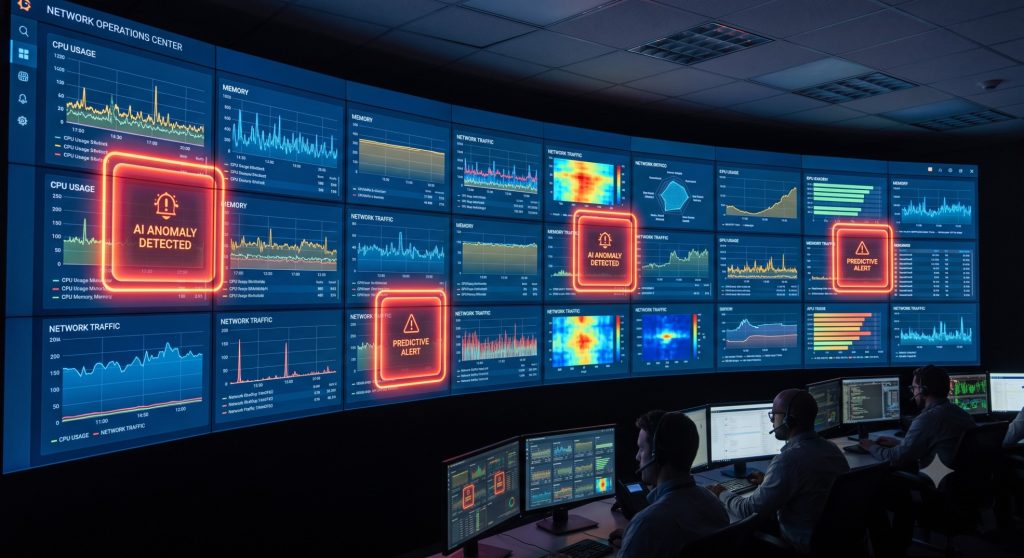
AIOps (Artificial Intelligence for IT Operations) applies machine learning to the logs, metrics, traces, and events your servers already produce. Instead of a human scanning dashboards, algorithms continuously correlate signals across your entire estate to detect anomalies, identify root causes, and in many cases trigger remediation automatically. Applied to server management, AIOps for server management turns raw monitoring data into three practical outcomes:
- Earlier detection. Anomaly models flag a failing disk, a memory leak, or an unusual traffic pattern hours before it breaches a threshold and pages your on-call engineer.
- Faster diagnosis. Event correlation groups hundreds of related alerts into one incident with a probable root cause, so engineers fix problems instead of triaging noise.
- Automated recovery. Known issues — a stuck service, a full log partition, a runaway process — can be corrected automatically with guardrails in place, before customers ever notice.
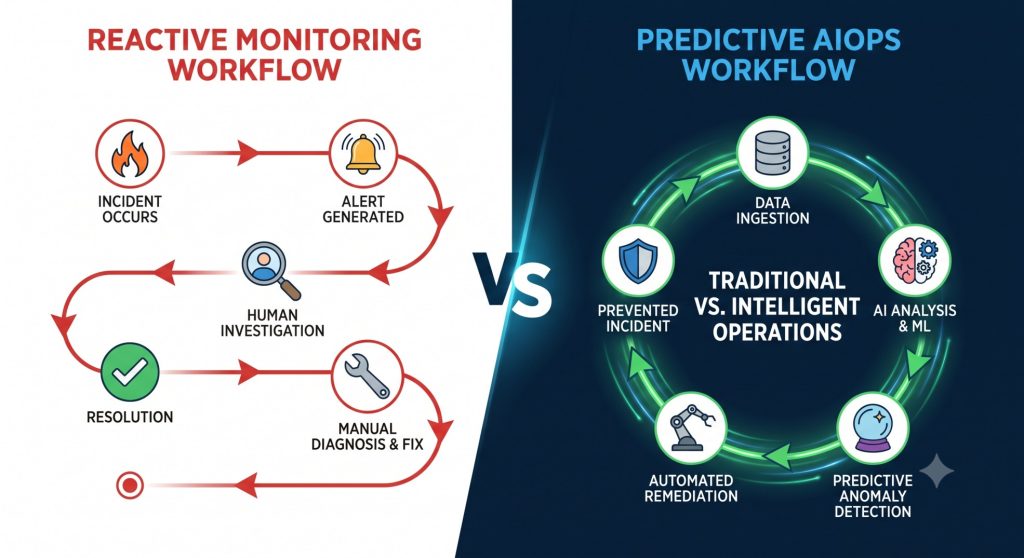
In other words, the goal is a shift from reactive firefighting to predictive operations. Traditional monitoring tells you that something broke; AIOps for server management tells you what is about to break, why, and what to do about it. It is also worth clarifying where this fits alongside related trends we have covered before: AI-powered cloud infrastructure is about intelligently provisioning and scaling resources, and preemptive cybersecurity is about stopping attackers. AIOps, by contrast, is about keeping everything running: uptime, incident response, and the day-to-day health of your servers.
Why 2026 Is the Tipping Point
Three forces are converging this year. First, infrastructure complexity has exploded: a single business application may now span containers, virtual servers, public cloud services, and third-party APIs. A single incident can touch all of them at once, which makes manual correlation practically impossible. Second, observability has become a P&L issue rather than a back-office metric — industry analysts point to multicloud complexity and AI-native operations as the defining operational pressures of 2026. Third, the technology itself has matured. As TierPoint’s 2026 infrastructure trends analysis notes, IT leaders are building distributed architectures with unified governance and integrated observability across platforms — and AIOps is the layer that makes that observability actionable.
Moreover, the newest generation of tooling is agentic. Rather than only detecting and recommending, modern AIOps platforms can diagnose an issue, trigger an approved action, verify the outcome, and learn from the result. The practical effect is ticketless remediation for routine incidents and genuinely self-healing server environments for known failure modes.
Five Ways AIOps Transforms Day-to-Day Server Operations
- Alert noise reduction. ML-based grouping typically collapses thousands of raw alerts into a handful of actionable incidents. The difference between 200 alerts and 3 meaningful ones is the difference between panic and focus.
- Predictive failure detection. Trend analysis on disk I/O, memory pressure, and error rates catches degradation early — preventing the 2 a.m. outage instead of resolving it.
- Lower MTTD and MTTR. Automated root-cause analysis cuts mean time to detect and mean time to resolve, the two metrics that most directly determine customer-facing uptime.
- Smarter capacity planning. Usage forecasting tells you when to scale — and, just as importantly, when not to — which feeds directly into cloud cost control on AWS and Azure environments.
- Automated remediation with guardrails. Runbook automation handles service restarts, cache flushes, log rotation, and failovers under policy, freeing engineers for higher-value work.
Getting Started: A Practical AIOps Roadmap
The first step is not buying an AIOps tool. It is establishing a unified observability baseline: consistent telemetry from every server, a coherent map of dependencies, and a shared definition of what “healthy” looks like across cloud, on-premises, and edge environments. From there, a sensible rollout looks like this:
- Consolidate logs, metrics, and events from across your data center and virtual infrastructure into a single observability pipeline.
- Start with alert noise reduction and event correlation — the fastest, lowest-risk win that builds team trust in the system.
- Layer in anomaly detection and predictive alerts for your most business-critical servers first, including cPanel and control-panel environments where a single node often hosts dozens of client sites.
- Introduce automated remediation gradually, beginning with read-only diagnostics, then low-risk actions, integrated with your DevOps pipelines and change controls.
- Measure relentlessly: track MTTD, MTTR, alert-to-incident ratio, and prevented incidents to prove ROI.
As a result, most teams see measurable improvement within a quarter — not because the AI is magic, but because it removes the noise that was hiding real problems all along.
How VIPoint Delivers AIOps-Driven Server Management
At VIPoint Solutions, we believe the winning model is AI plus experienced engineers, not AI instead of them. Our 24/7 NOC teams combine AIOps tooling — intelligent alerting, event correlation, and automated runbooks — with senior Linux administrators who validate every high-impact action. Because our team operates around the clock from Infopark, Kochi, US and European clients get native overnight coverage without paying night-shift premiums. We apply this model across physical server management, virtual server environments, and multi-cloud estates, and our AI and machine learning expertise means we can also build custom anomaly-detection pipelines when off-the-shelf tools fall short. For hosting providers, this pairs naturally with white-labeled helpdesk support so your customers see faster resolutions under your brand.

The Bottom Line
Downtime is expensive, engineers are scarce, and infrastructure is only getting more complex. Consequently, AIOps for server management is no longer a luxury for hyperscalers — it is the practical path to higher uptime and lower operational cost for any business running servers at scale. The organizations that adopt it in 2026 will spend less time firefighting and more time building.
Ready to make your infrastructure predictive? Contact VIPoint Solutions for a free server operations assessment — we will show you exactly where AIOps can cut your alert noise and your downtime.