
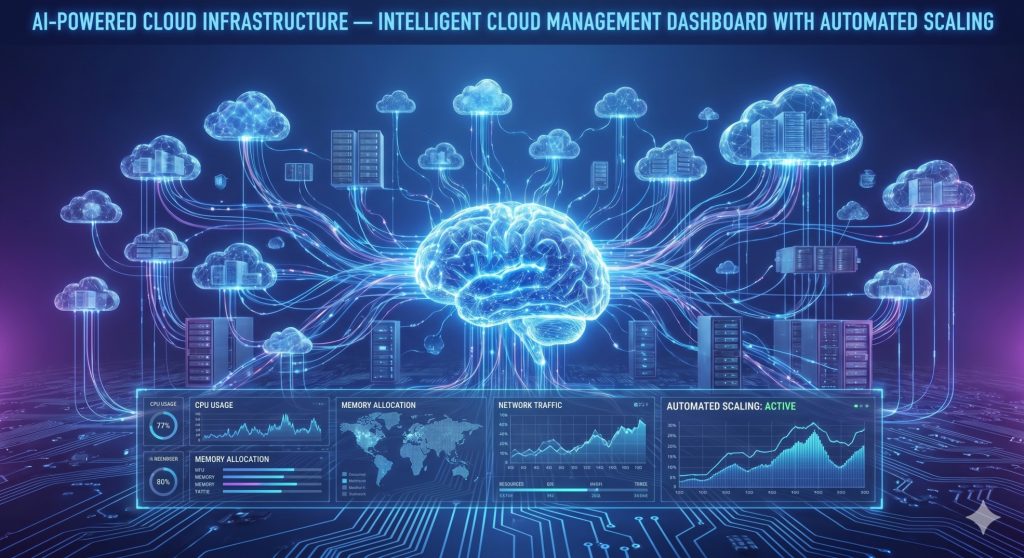
AI-powered cloud infrastructure is transforming how businesses build, manage, and scale their IT operations in 2026. The era of manually provisioning servers, guessing capacity requirements, and overpaying for idle resources is ending. Instead, AI now handles cloud optimization autonomously — predicting demand, auto-scaling resources, detecting anomalies, and reducing costs without human intervention. Furthermore, leading analysts at Capgemini have identified this shift as “Cloud 3.0” — the next evolution of cloud computing where intelligence is built directly into the infrastructure layer. If your business still manages cloud the old way, you are leaving money and performance on the table.
What Is AI-Powered Cloud Infrastructure and Why Is It Called Cloud 3.0?
To understand this shift, consider how cloud computing has evolved. Cloud 1.0 was about moving from physical servers to virtual machines. Cloud 2.0 brought containers, microservices, and multi-cloud strategies. However, AI-powered cloud infrastructure represents Cloud 3.0 — where the cloud itself becomes intelligent and self-managing.
Specifically, AI-powered cloud infrastructure uses machine learning models embedded directly into the cloud management layer. These models continuously analyze workload patterns, resource utilization, security events, and cost data. As a result, they make real-time decisions about scaling, load balancing, and resource allocation that would take human teams hours or days to implement.
For example, instead of setting static auto-scaling rules that react after traffic spikes, AI predicts traffic patterns based on historical data and pre-scales resources before the spike arrives. Similarly, AI identifies underutilized instances and automatically right-sizes them. Moreover, according to Capgemini’s Top Tech Trends 2026 report, cloud is entering its next evolution where AI becomes the backbone of digital infrastructure, shifting from isolated proofs of concept to coherent, adaptive value systems.
How AI-Powered Cloud Infrastructure Reduces Costs and Boosts Performance
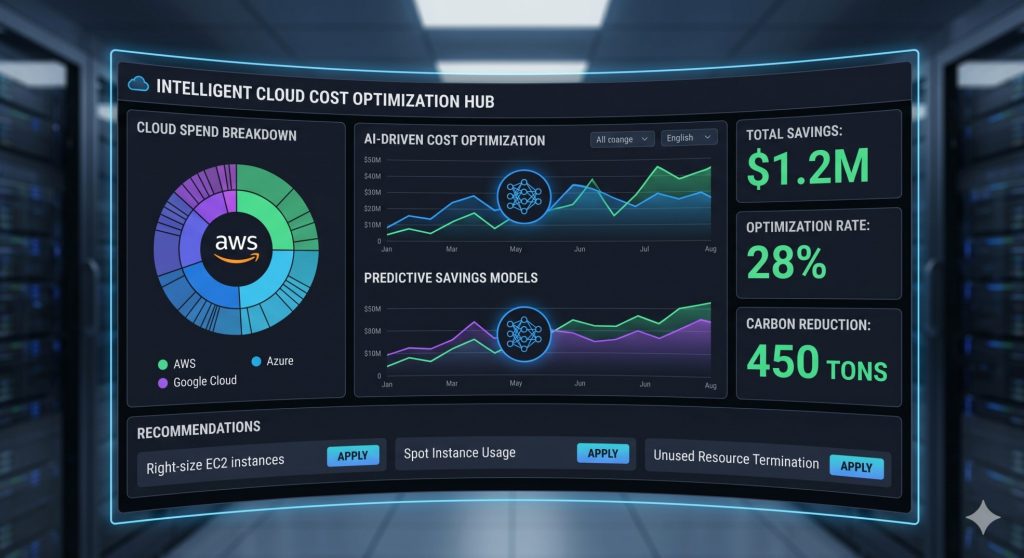
The financial impact of AI-powered cloud infrastructure is substantial. Most businesses overspend on cloud by 20–35% because they over-provision resources to avoid downtime. Additionally, complex multi-cloud environments make it nearly impossible for human administrators to track every instance, storage volume, and network configuration in real time.
In particular, here are the key areas where AI delivers measurable cloud savings:
- Intelligent Auto-Scaling: AI predicts demand curves and scales resources proactively, eliminating both over-provisioning waste and under-provisioning performance issues.
- Right-Sizing Recommendations: AI continuously analyzes CPU, memory, and storage utilization across every instance and recommends optimal configurations.
- Spot Instance Optimization: AI automatically shifts non-critical workloads to discounted spot or preemptible instances, saving up to 70% on compute costs.
- Anomaly Detection: AI identifies unusual spending patterns and resource consumption spikes that indicate misconfigurations, runaway processes, or security breaches.
- Multi-Cloud Cost Arbitrage: AI compares pricing across AWS, Azure, and GCP in real time and routes workloads to the most cost-effective provider.
Consequently, businesses that adopt AI-powered cloud infrastructure typically see a 25–40% reduction in their monthly cloud bills. At VIPoint Solutions, our AWS managed services team helps businesses implement intelligent cost optimization across their entire cloud estate.
AI-Powered Cloud Infrastructure for Security and Compliance
Cost optimization is just one benefit. Equally important, AI-powered cloud infrastructure dramatically strengthens your security posture. Traditional cloud security relies on static rules and periodic audits. However, AI introduces continuous, adaptive security that evolves with emerging threats.
For instance, AI monitors every API call, network connection, and user action across your cloud environment. It establishes behavioral baselines and immediately flags deviations. If a developer account suddenly starts downloading large datasets at 2 AM, the system isolates the activity and alerts your security team within seconds. Similarly, AI scans infrastructure-as-code templates before deployment to catch misconfigurations that could expose sensitive data.
Additionally, compliance becomes significantly easier with AI. Regulations like GDPR, HIPAA, and SOC 2 require continuous monitoring and documentation. AI automates compliance checks, generates audit trails, and ensures that your cloud configurations meet regulatory requirements at all times. According to Wavestone’s Technology Trends 2026 report, AI-ready cloud infrastructure is essential for closing exposed security zones while maintaining enterprise-scale governance.
Therefore, businesses that combine our server management services with Azure cloud management get a comprehensive security layer that covers both on-premise and cloud infrastructure.
Building Your AI-Powered Cloud Infrastructure: A Practical Roadmap
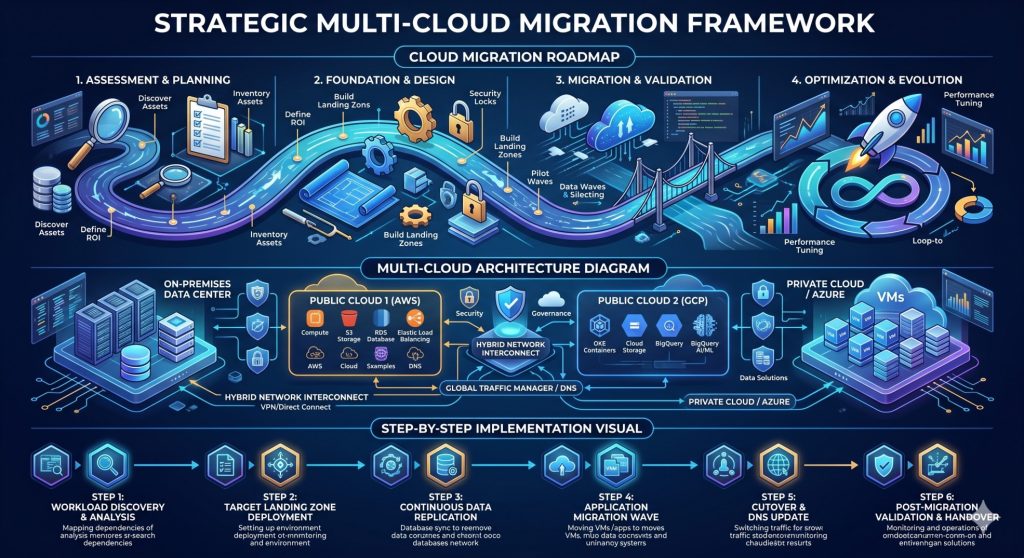
Transitioning to AI-powered cloud infrastructure does not require a complete overhaul. On the contrary, the smartest approach is incremental adoption. Here is a proven roadmap that works for businesses at any stage of cloud maturity.
First, conduct a thorough cloud audit. Document every resource across your AWS, Azure, or OpenStack environments. Identify idle instances, oversized volumes, and orphaned resources. This baseline assessment alone often reveals 15–25% in immediate savings. Our OpenStack management team regularly conducts these audits for clients running private cloud environments.
Second, implement AI-driven monitoring and observability. Deploy tools that provide real-time visibility into performance, costs, and security across your entire stack. Subsequently, these tools establish baselines that AI models use for anomaly detection and predictive scaling.
Third, automate your deployment pipelines with AI-enhanced CI/CD. Integrate AI into your DevOps workflows so that every deployment is automatically tested, optimized, and monitored. AI can predict deployment failures before they happen, suggest rollback decisions, and optimize release schedules based on traffic patterns.
Finally, establish continuous optimization loops. AI-powered cloud infrastructure is not a one-time setup. Instead, it learns and improves over time. The longer your AI models observe your workload patterns, the more accurate their predictions and recommendations become. Meanwhile, your VMware virtualization and virtual server environments can also benefit from the same AI-driven optimization principles.
Why VIPoint Solutions Is Your Partner for AI-Powered Cloud Infrastructure
Managing AI-powered cloud infrastructure requires deep expertise across multiple platforms, security frameworks, and automation tools. At VIPoint Solutions, we bring over a decade of hands-on cloud management experience serving businesses worldwide from our headquarters at Infopark, Kochi.
In addition, our team holds certifications across AWS, Azure, VMware, and OpenStack. Whether you need to migrate from legacy infrastructure, optimize an existing multi-cloud setup, or build an AI-driven cloud strategy from scratch, we have the expertise to deliver. Our web development team also builds cloud-native applications designed for AI-powered environments from the ground up.
Moreover, we provide 24/7 monitoring and incident response through our helpdesk support services, ensuring that your cloud infrastructure runs smoothly around the clock. According to Deloitte’s Tech Trends 2026, IT operating models built for service delivery alone are no longer sufficient — businesses need partners who can drive transformation. That is exactly what VIPoint delivers.
Ready to upgrade to AI-powered cloud infrastructure? Contact VIPoint Solutions today for a free cloud assessment. Our experts will audit your current setup and design an intelligent cloud strategy that cuts costs, boosts performance, and future-proofs your business.