
Azure vs AWS is the first real decision most businesses face when moving to the cloud — and in 2026, the answer is less obvious than ever. AWS still leads the market, but Azure is growing faster and closing the gap every quarter. Meanwhile, cloud spending has hit record levels: global cloud infrastructure spending reached $129 billion in Q1 2026 alone, up 35% year over year. Choosing the wrong platform means higher bills, harder migrations, and slower delivery for years. This guide compares both platforms on the factors that actually matter — market position, pricing, enterprise fit, AI capabilities, and real-world scenarios — so you can decide with confidence.
Azure vs AWS in 2026: Market Position and Momentum
First, the numbers. According to Synergy Research Group data for Q1 2026, AWS holds roughly 28% of the global cloud infrastructure market, Azure holds about 21%, and Google Cloud sits at 14%. Together, the big three control nearly two-thirds of all cloud spending worldwide.
However, market share only tells half the story. Momentum matters just as much. Azure revenue is growing at around 40% year over year — significantly faster than AWS — driven largely by enterprise AI workloads and deep Microsoft 365 integration. AWS, meanwhile, posted its fastest growth in 15 quarters and remains the first cloud business to cross a $150 billion annualized run rate. In other words, neither platform is “winning” outright: AWS leads on scale and service breadth, while Azure leads on enterprise momentum.
Additionally, around 75% of enterprises now run multi-cloud environments. Therefore, the real question in the Azure vs AWS debate is not “which one forever” — it is “which one for this workload, right now.”
Azure vs AWS Pricing: Where the Real Cost Differences Lie
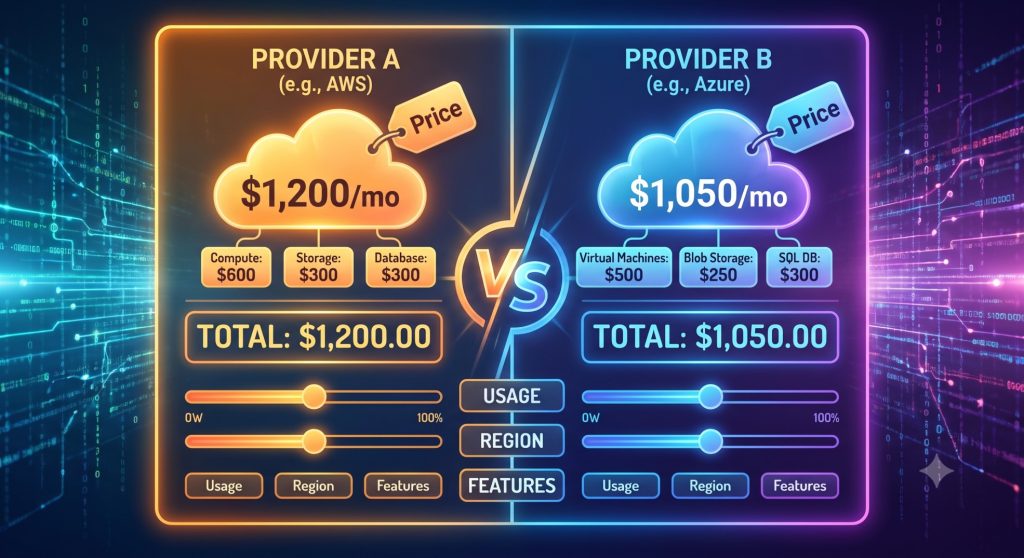
Pricing is where most Azure vs AWS comparisons go wrong, because list prices are nearly identical. The real cost differences come from how each platform charges for the things around compute:
- Licensing: If you run Windows Server or SQL Server, Azure Hybrid Benefit lets you reuse existing licenses and can cut those workload costs by 40–80%. AWS charges full price for Microsoft licensing.
- Egress and networking: Data transfer out is a hidden cost on both platforms, but pricing tiers differ by region. High-traffic applications need this modeled before migration, not after.
- Commitment discounts: AWS Savings Plans are more flexible; Azure Reservations pair better with enterprise agreements. Choosing the wrong commitment model wastes 20–30% of potential savings.
- Support plans: AWS Business support starts at 10% of monthly spend; Azure support tiers are flat-priced. At scale, this difference is real money.
Consequently, the cheaper platform depends entirely on your workload profile. A Microsoft-heavy enterprise almost always saves on Azure; a Linux-first, container-heavy product company usually runs leaner on AWS. At VIPoint Solutions, our AWS managed services and Azure management services teams model both scenarios before recommending a platform — because the right answer is a calculation, not an opinion.
Azure vs AWS for Enterprise Integration, AI, and Hybrid Cloud
Beyond price, three battlegrounds decide the Azure vs AWS question for most businesses in 2026.
Enterprise integration. Azure’s biggest advantage is the Microsoft ecosystem. If your business runs on Microsoft 365, Entra ID (Active Directory), Dynamics, and Teams, Azure plugs in natively — identity, security policies, and licensing flow through one vendor. AWS integrates with everything, but it integrates with Microsoft tools rather than being part of them.
AI capabilities. Azure offers frontier AI models through Azure AI Foundry, while AWS counters with Bedrock’s multi-model approach and custom silicon that lowers AI inference costs. Both are excellent; the deciding factor is usually which ecosystem your data already lives in. As we covered in our guide to AI-powered cloud infrastructure, AI is now embedded in the infrastructure layer itself — auto-scaling, cost optimization, and anomaly detection — on both platforms.
Hybrid and on-premises. Azure Arc and Azure Stack are more mature for businesses that must keep some workloads on-premises — common for compliance-bound industries. AWS Outposts is capable but assumes a more AWS-centric world. If you run VMware environments or a private OpenStack cloud, hybrid integration should weigh heavily in your decision.
Azure vs AWS: Which One Fits Your Business Scenario?
Instead of a generic verdict, here is how the Azure vs AWS decision typically plays out across real business scenarios we see at VIPoint:
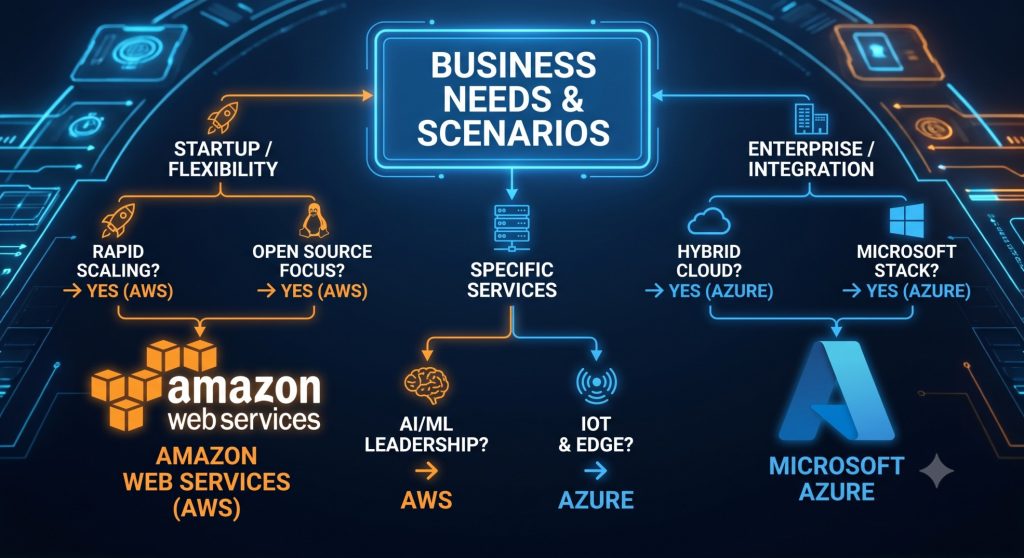
- Choose Azure if: you are a Microsoft-centric enterprise, you rely on Windows Server and SQL Server licensing, your identity layer is Entra ID, or you need mature hybrid cloud for compliance.
- Choose AWS if: you are building cloud-native products, run Linux and container-first architectures, need the widest service catalog and region coverage, or your engineering team already has deep AWS skills.
- Choose both if: you are large enough that different departments have different needs — which is why three out of four enterprises are already multi-cloud. Run Microsoft workloads on Azure and product workloads on AWS, with unified monitoring and governance.
Whichever direction you take, day-2 operations decide whether the platform delivers its promise. Patching, monitoring, incident response, and cost governance do not run themselves. Our server management services and DevOps services keep both AWS and Azure environments secure, optimized, and observable around the clock — and our recent post on AIOps for server management explains how AI now automates much of that operational load.
Beyond Azure vs AWS: Why the Right Partner Matters More Than the Platform
Here is the honest conclusion after a decade of managing both platforms: the Azure vs AWS choice matters less than how well the chosen platform is run. A well-architected Azure deployment beats a neglected AWS one every time — and vice versa. Misconfigured security groups, unmonitored spend, and unpatched instances cause more business damage than any platform limitation.
At VIPoint Solutions, we hold certifications across AWS, Azure, VMware, and OpenStack, and we manage production workloads on all of them from our base at Infopark, Kochi. We help businesses evaluate, migrate, and operate cloud environments with 24/7 monitoring through our helpdesk support services. According to industry analysis of the 2026 cloud market, the market is growing fast enough for both platforms to thrive — which means the winner of Azure vs AWS should be decided by your workloads, your licenses, and your team, not by hype.
Still weighing Azure vs AWS for your business? Contact VIPoint Solutions for a free cloud platform assessment. We will analyze your workloads, licensing, and growth plans, then give you a clear recommendation — with the numbers to back it up.