
Managed IT services now power the technology operations of 94% of small and mid-size organizations. In 2026, the global managed services market has reached roughly $460 billion. Yet every growing business faces the same question: hire our own IT team, or hand operations to a partner? The honest answer is “it depends” — but it depends on numbers you can actually calculate, not vendor slogans. This guide lays out the real costs and the downtime data. It also shows where in-house teams win, and how to evaluate a provider if you go managed.
What Managed IT Services Actually Cover in 2026
Managed IT services means handing defined IT operations — monitoring, maintenance, support, security, backups — to a specialist provider. You pay a predictable monthly fee instead of building every capability in-house. A mature provider typically covers:
- 24/7 monitoring and incident response: servers, websites, and applications watched around the clock. Engineers act on alerts before customers notice.
- Server and infrastructure management: patching, hardening, performance tuning, and capacity planning across physical, virtual, and cloud environments.
- Helpdesk support: a staffed desk answering user and customer issues by phone, chat, and ticket — with defined SLAs.
- Security and backup operations: firewall management, malware response, backup verification, and disaster recovery drills.
- Cloud and DevOps operations: managing AWS/Azure environments, deployments, and cost optimization as ongoing disciplines rather than projects.
It is the same work an internal team would do. The difference: a bench of specialists replaces one or two generalists. In fact, businesses have clearly done this math. According to MarketsandMarkets’ 2026 analysis, the market will grow to over $700 billion by 2031.
Managed IT Services vs In-House IT: The Real Cost Comparison
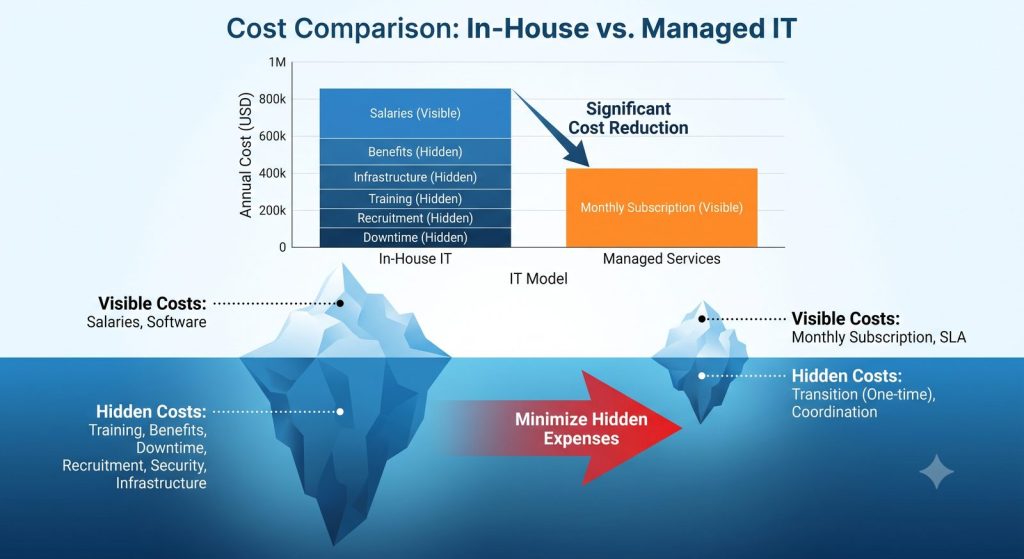
Start with what an in-house team truly costs. A single capable system administrator in India costs ₹6–12 lakh per year fully loaded; in the US, $90,000–140,000. But one person cannot provide 24/7 coverage. Genuine round-the-clock operations need four to five engineers once you account for shifts, weekends, leave, and attrition. Add recruitment, training, tooling licences, and the management overhead of running that team, and the real number surprises most founders.
Against that, the benchmarks for managed IT services are well documented. A 2026 pricing analysis across 47 US metros puts fully-managed IT at roughly $100–200 per user per month. Notably, 24-hour coverage lifts in-house-equivalent costs by 30–50%. That is precisely where an India-based NOC like ours changes the economics. Meanwhile, the outcome data is consistent across studies:
- 20–30% lower overall IT costs for organizations using managed services, with productivity gains of 15–25% (Research and Markets, via Integris).
- 45% less unplanned downtime compared with in-house-only IT management (CompTIA). Downtime, not salaries, is usually the biggest hidden cost.
- ~28% average reduction in total cost of ownership, with predictable monthly spend replacing lumpy capital and emergency expenses.
Interestingly, cost is no longer even the main driver. Only a third of organizations now cite it as their main reason to outsource IT, down from 70% in 2020. The bigger motivators are specialist skills, coverage, and reliability. These are structurally hard for a small internal team to provide.
Beyond Cost: Why Businesses Outsource IT Operations in 2026
Three advantages matter more than the invoice:
Depth of expertise on demand. One in-house hire knows one stack. A managed team spans Linux and Windows, cPanel and Kubernetes, AWS and Azure, databases and security. Moreover, someone on the bench has already solved whatever broke today. That breadth is why our server management and helpdesk support services resolve incidents that stall single-admin setups for days.
True 24/7 coverage. Attacks and outages do not respect office hours. As we detailed in our Linux server hardening checklist, automated scanners probe new servers within minutes, around the clock. A managed NOC watches while your team sleeps. For US and European businesses, an India-based team covers their night as our working day.
Process maturity. Providers live and die by SLAs, runbooks, monitoring baselines, and tested recovery procedures. Most internal teams only intend to build these “when things calm down.” Our guides to AIOps-driven operations and disaster recovery planning describe exactly the machinery a mature provider brings on day one.
When Outsourcing Is Not the Right Answer
Honesty time: outsourcing everything is not always correct. In-house wins when IT is your product — a software company’s core platform engineering belongs in-house, close to the product. It also wins for deep, daily business-context work. An engineer embedded in your operations understands workflows no external partner will match. And for a tiny environment of a few laptops and SaaS apps, a part-time consultant may be all you need.
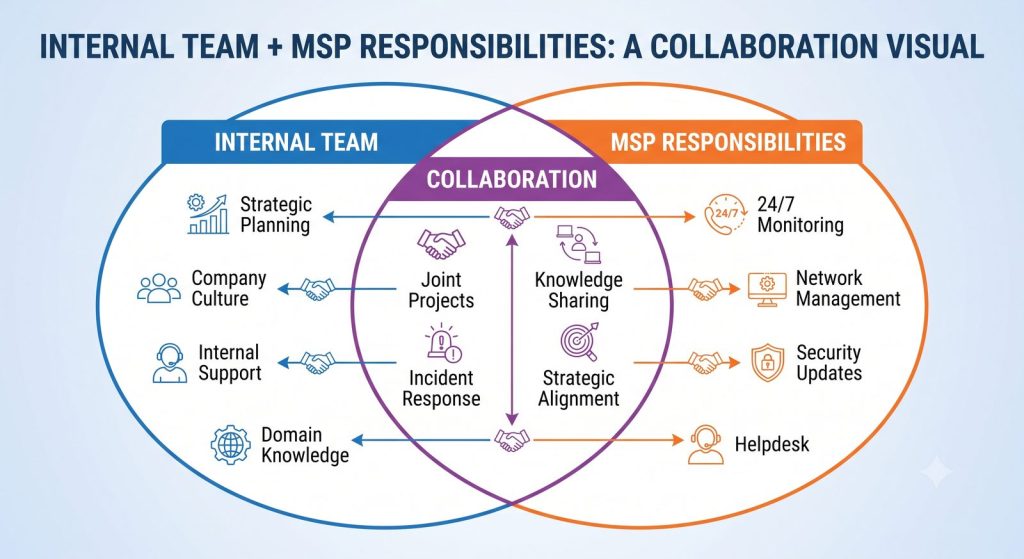
For most growing businesses, though, the practical answer in 2026 is co-managed IT. First, keep a lean internal team for strategy and business-context work. Then hand the 24/7 operational layer — monitoring, patching, backups, incident response, helpdesk — to a managed partner. You keep control; you stop paying for night shifts. Most of our long-term clients run this model. They combine their internal staff with our virtual server management, cPanel server management, and DevOps services.
Choosing a Managed IT Services Partner: What Actually Matters
If you go managed, evaluate providers on the things that predict outcomes, not the glossiness of the proposal:
- Written SLAs with teeth: response and resolution times per severity, measured and reported monthly — not “best effort.”
- Real 24/7 engineering, not an answering service: ask who touches the server at 3 AM, and how they escalate.
- Proactive posture: patching cadence, hardening baselines, backup restore tests, and monitoring tuning. Ask to see last month’s reports for an existing client.
- Transparent offboarding: you own your credentials, documentation, and configurations; a good provider proves it in the contract.
- Breadth that matches your stack: your provider should already run your technologies at scale. That could be bare-metal Linux, VMware, cPanel fleets, or AWS and Azure.
At VIPoint Solutions, we have delivered managed IT and server operations from Infopark, Kochi since 2012. We run 24/7 monitoring, server management, cloud operations, and helpdesk for clients across the US, Europe, and beyond. As a result, our clients get a full operations team of Linux engineers, cloud specialists and support staff. Moreover, that team costs less than two local hires.
Weighing managed IT services against hiring? Contact VIPoint Solutions for a free cost comparison mapped to your actual infrastructure. We will show you the numbers side by side: in-house, fully managed, and co-managed. Then you can decide with data.