
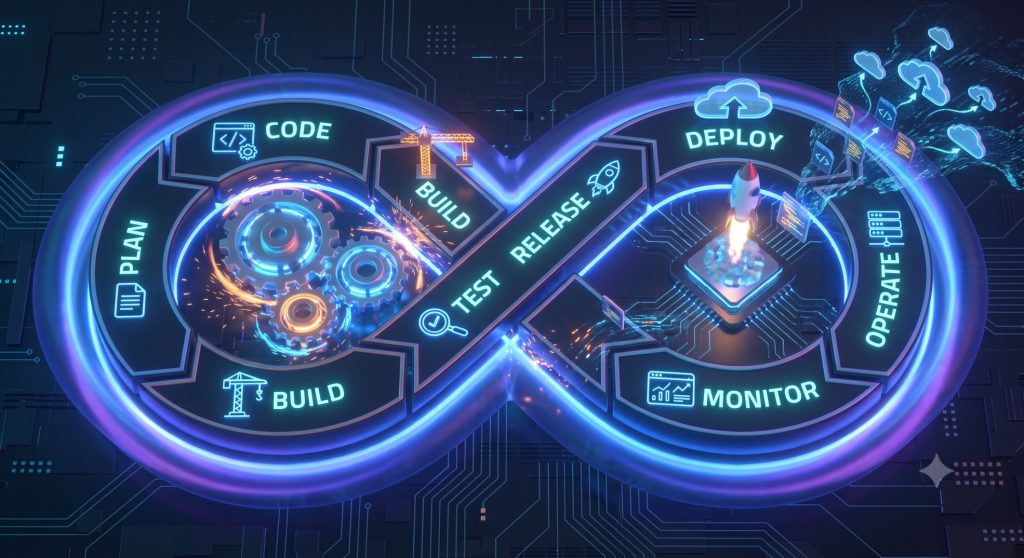
DevOps best practices separate teams that ship confidently every day from teams that fear every release. In 2026, the gap between the two has never been wider. The global DevOps market has reached $19.57 billion, AI now writes a significant share of production code, and Gartner predicts that 80% of large engineering organizations will run dedicated platform teams this year — up from 45% in 2022. However, tools alone do not create velocity. Teams that adopt DevOps best practices ship faster, fail less, and recover in minutes instead of days — while teams that skip the fundamentals just automate their chaos. This guide covers the practices that actually move the needle in 2026.
Why DevOps Best Practices Matter More Than Ever in 2026
First, the context has changed. AI-assisted development means code gets written faster than ever — but DORA research shows that AI only improves outcomes when the underlying delivery system already works well. In teams with weak pipelines and poor visibility, AI amplifies problems instead of solving them: more code, shipped faster, breaking more things.
Additionally, the cost of downtime keeps rising. Businesses now run customer-facing applications, internal tools, and AI workloads on the same infrastructure, so a single failed deployment can hit revenue, operations, and reputation at once. Consequently, DevOps best practices are no longer an engineering preference — they are a business risk control. The practices below are organized from foundational to advanced, so you can benchmark where your team stands.
Core DevOps Best Practices: CI/CD, Infrastructure as Code, and Automated Testing
Every high-performing team gets three fundamentals right before anything else:
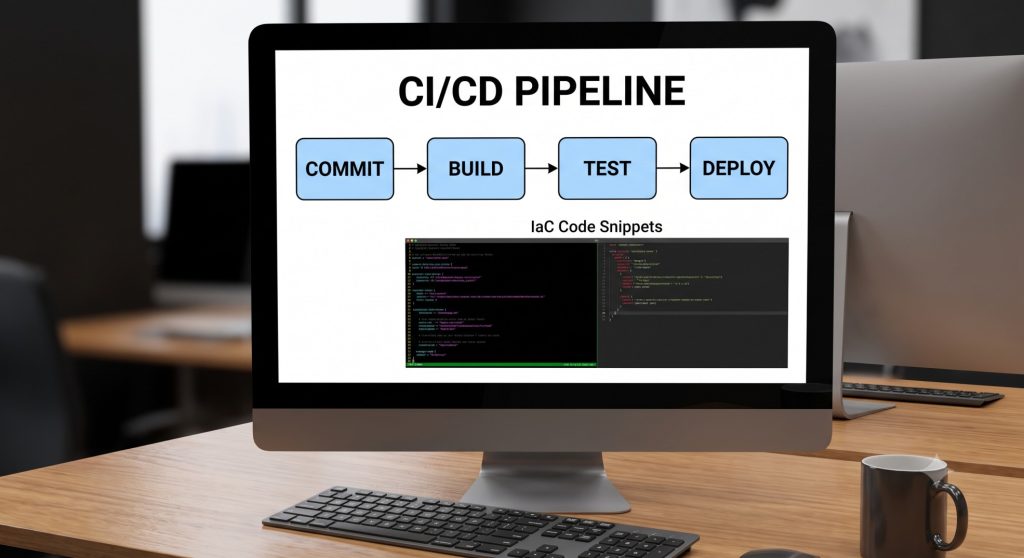
- Continuous Integration and Continuous Delivery (CI/CD): Every code change is automatically built, tested, and made deployable. Small, frequent releases beat big quarterly ones — smaller changes mean smaller blast radius and faster rollback when something goes wrong.
- Infrastructure as Code (IaC): Servers, networks, and cloud resources are defined in version-controlled code (Terraform, Ansible), not clicked together in consoles. Environments become reproducible, auditable, and disposable — no more “works on staging, breaks in production.”
- Automated testing at every stage: Unit tests on commit, integration tests on merge, smoke tests on deploy. The pipeline blocks bad code automatically, so quality does not depend on someone remembering to check.
- Version control for everything: Application code, infrastructure definitions, pipeline configs, and database migrations all live in Git. If it is not in version control, it does not exist.
These fundamentals apply whether you deploy to AWS, Azure, or on-premises infrastructure. In fact, if you are still choosing a platform, our recent Azure vs AWS comparison breaks down which cloud fits which workload — but the DevOps practices remain the same on both.
DevOps Best Practices for Security and Reliability: DevSecOps and Observability
Second, security and reliability must be built into the pipeline, not bolted on afterward. Two practices define this in 2026:
DevSecOps — shift security left. Vulnerability scanning, dependency checks, and secret detection run automatically inside the CI/CD pipeline, catching issues before they reach production. This matters more after high-profile supply chain attacks compromised hundreds of open-source packages — software supply chain security is now a board-level topic, not just a security team concern. Practically, that means scanning container images, pinning dependencies, and signing artifacts as standard pipeline steps.
Observability — measure everything. Logs, metrics, and traces flow into a unified monitoring stack so teams see problems before customers do. Track the DORA metrics — deployment frequency, lead time, change failure rate, and time to restore — to know objectively whether your delivery is improving. Moreover, as we explained in our guide to AIOps for server management, AI now analyzes those signals to predict incidents and trigger self-healing responses before outages happen. Reliable observability is also the foundation of the 24/7 server management we provide for client infrastructure.
Modern DevOps Best Practices: GitOps, Platform Engineering, and AIOps
Third, the leading edge. These practices define what “good” looks like in 2026:
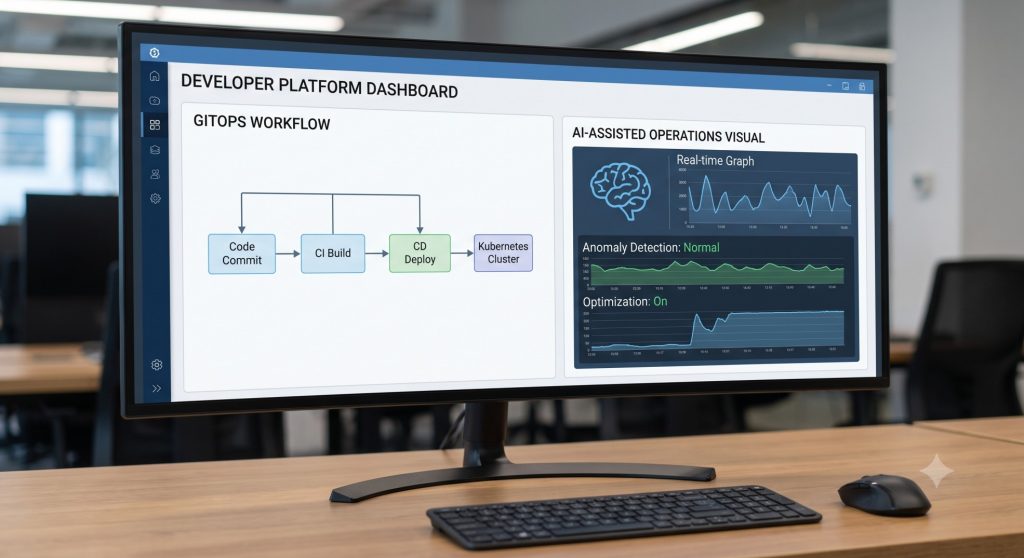
- GitOps: Git becomes the single source of truth for what runs in production. Tools like ArgoCD continuously reconcile the live environment against the repository — deployments become pull requests, and rollbacks become reverts.
- Platform engineering: Instead of every team building its own pipelines, a platform team provides “golden paths” — pre-approved, self-service workflows for deployment, secrets, and environments. According to Gartner’s platform engineering research, 80% of large engineering organizations are establishing platform teams — and DORA data shows 93% of top-performing teams use internal developer platforms.
- AIOps in the pipeline: AI reviews code, predicts deployment risk, tunes alert thresholds, and automates root cause analysis. Teams using AI assistance complete tasks up to 55% faster — but only when the pipeline fundamentals from section two are already in place.
- Blameless culture: Post-incident reviews focus on fixing systems, not blaming people. Teams that punish failure hide failure — and hidden failures become outages.
The common thread: reduce the cognitive load on developers so they ship product instead of fighting infrastructure. That is the entire promise of DevOps, finally maturing.
Putting DevOps Best Practices to Work With VIPoint Solutions
Finally, the honest part: most teams cannot adopt all of this at once — and they should not try. The right sequence is fundamentals first (CI/CD, IaC, automated testing), then security and observability, then GitOps and platform engineering as the team scales. Skipping steps is how companies end up with impressive tooling and unreliable releases.
At VIPoint Solutions, our DevOps services team builds and operates CI/CD pipelines, Infrastructure as Code, containerized deployments, and monitoring stacks for businesses worldwide from Infopark, Kochi. We combine DevOps implementation with web development, virtual server management, and 24/7 helpdesk support — so the pipeline we build keeps working long after go-live. Whether you are starting from manual deployments or scaling toward platform engineering, we meet your team where it is and take it forward step by step.
Ready to make your releases boring — in the best possible way? Contact VIPoint Solutions for a free DevOps maturity assessment. We will benchmark your current delivery process against these best practices and give you a prioritized roadmap.