

Multi-agent AI for business is rapidly becoming the most important technology investment companies can make in 2026. Instead of relying on a single AI chatbot to handle every task, forward-thinking organizations are now deploying teams of specialized AI agents that collaborate, delegate, and execute complex workflows autonomously. As a result, businesses are seeing dramatic improvements in efficiency, accuracy, and speed across every department. Furthermore, Gartner predicts that 33% of enterprise software will include agentic AI capabilities by 2028, up from less than 1% in 2024. The question is no longer whether your business needs multi-agent AI — it is how quickly you can implement it.
What Is Multi-Agent AI for Business and Why Is It Trending?
To understand the hype, you first need to understand the shift. Traditional AI tools operate as single-purpose assistants. You ask a question, and you get an answer. However, multi-agent AI for business works fundamentally differently. Instead of one AI doing everything, multiple specialized agents work together as a coordinated team.
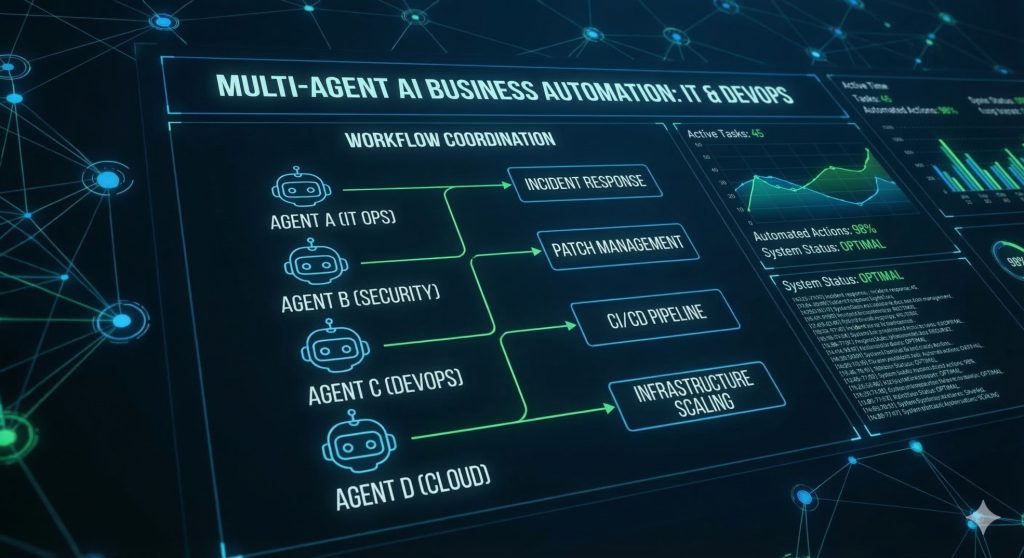
For instance, one agent might monitor your server health around the clock. Another agent could analyze customer support tickets and route them to the right department. Meanwhile, a third agent generates weekly performance reports and sends them to your leadership team. Additionally, these agents communicate with each other, share context, and adjust their actions based on what other agents discover.
Consequently, you get an AI-powered workforce that handles repetitive, complex, and time-sensitive tasks without human bottlenecks. Moreover, according to a KPMG Global Tech Report 2026, 92% of tech executives say managing AI agents will become a critical skill within five years. This is not a future trend. It is happening right now.
How Multi-Agent AI for Business Automates Real Workflows
The real power of multi-agent AI becomes clear when you see it applied to actual business operations. Specifically, here are the areas where companies are deploying agent teams right now:
- IT Operations and Server Management: AI agents monitor servers 24/7, detect anomalies, auto-scale resources, and trigger remediation scripts — all without waiting for a human ticket.
- Customer Support and Helpdesk: One agent triages incoming requests while another resolves known issues automatically. A third escalates complex problems to your human team with full context attached.
- DevOps and CI/CD Pipelines: Agents review code, run tests, flag vulnerabilities, and deploy updates in a coordinated pipeline that dramatically reduces release cycles.
- Cloud Cost Optimization: Specialized agents continuously analyze your AWS, Azure, or GCP usage and right-size instances to eliminate waste.
- Web Application Monitoring: Agents track uptime, page speed, and user experience metrics, then coordinate with DevOps agents to fix issues before customers notice.
In particular, at VIPoint Solutions, our server management team is already integrating AI-powered monitoring that works alongside human administrators. Similarly, our helpdesk support services use intelligent ticket routing to resolve issues faster.
The Business Case for Multi-Agent AI: Cost Savings and ROI
Of course, technology decisions ultimately come down to numbers. Therefore, let us look at what multi-agent AI for business actually delivers in terms of return on investment.
First, there is the staffing advantage. A single team of AI agents can monitor, analyze, and respond to infrastructure issues across hundreds of servers simultaneously. In contrast, human teams require shifts, handovers, and sleep. Additionally, agent-based systems reduce Mean Time to Resolution (MTTR) by up to 60%, according to Deloitte’s Tech Trends 2026 report. This translates directly to reduced downtime costs.
Second, there is the accuracy benefit. Human operators make mistakes during repetitive tasks, especially during late-night shifts. However, AI agents maintain consistent accuracy regardless of time or workload. As a result, your error rates drop and your service quality improves.
Finally, there is the scalability factor. When your business grows, you do not need to hire proportionally more staff. Instead, you deploy additional AI agents that integrate seamlessly with your existing agent teams. This is precisely why companies working with VIPoint’s DevOps services are able to scale their operations faster and more cost-effectively.
Multi-Agent AI for Business: Getting Started Without Overwhelm
Many business owners feel overwhelmed by the complexity of AI adoption. Nevertheless, deploying multi-agent AI for business does not require rebuilding your entire technology stack overnight. On the contrary, the best approach is to start small and expand strategically.
To begin, identify the most repetitive and time-consuming tasks in your organization. Typically, these include server monitoring, ticket management, routine code deployments, and cloud resource management. Subsequently, deploy a single AI agent to handle one of these tasks. Once you see the results, add more agents to cover adjacent workflows.
In addition, you need the right infrastructure to support AI agents. This means reliable servers, well-configured cloud environments, and robust CI/CD pipelines. For example, our AWS managed services ensure your cloud infrastructure is optimized and ready to support agent-based workloads. Likewise, our web development team builds applications with AI integration in mind from day one.
Moreover, according to Capgemini’s Top Tech Trends 2026, AI is now redefining the entire software lifecycle — from development to deployment to maintenance. Organizations that embrace this shift early will gain a significant competitive edge.

Why 2026 Is the Year to Invest in Multi-Agent AI for Business
The timing has never been better. Specifically, three factors make 2026 the ideal year to adopt multi-agent AI for business.
First, AI models have become significantly more affordable. The cost of running AI inference has dropped by over 80% since 2024. Consequently, even small and mid-sized businesses can now afford to deploy multiple AI agents without breaking their budget.
Second, integration tools have matured. Frameworks and platforms for orchestrating multi-agent systems are now production-ready. Therefore, you no longer need a team of AI researchers to build an agent-based system. Meanwhile, cloud providers like AWS and Azure offer native agent orchestration services.
Third, your competitors are moving fast. According to industry research, companies that delay AI adoption by even 12 months risk falling permanently behind in operational efficiency. In particular, businesses in IT services, hosting, e-commerce, and SaaS are leading the charge.
At VIPoint Solutions, we help businesses navigate this transition with confidence. Our team combines deep expertise in AI and machine learning with hands-on experience in chatbot development to deliver agent-based solutions that work in the real world.
Ready to deploy multi-agent AI for your business? Contact VIPoint Solutions today for a free consultation. Our AI and DevOps experts will assess your current operations and design an agent-based strategy tailored to your needs.