
An AI-ready website is no longer a luxury — it is a business necessity in 2026. Your website is not just a digital brochure anymore. Instead, it is the primary interface between your business and an AI-powered world. However, most business websites are not prepared for this shift.
Search engines are changing rapidly. Users are interacting differently than before. As a result, websites that fail to adapt will quietly disappear from search results. Moreover, they will lose customer consideration and revenue. This applies to every business — from a startup in Kochi to an enterprise in New York. In other words, understanding what makes a website AI-ready is critical for survival.
How AI Is Changing the Way People Find Your AI-Ready Website
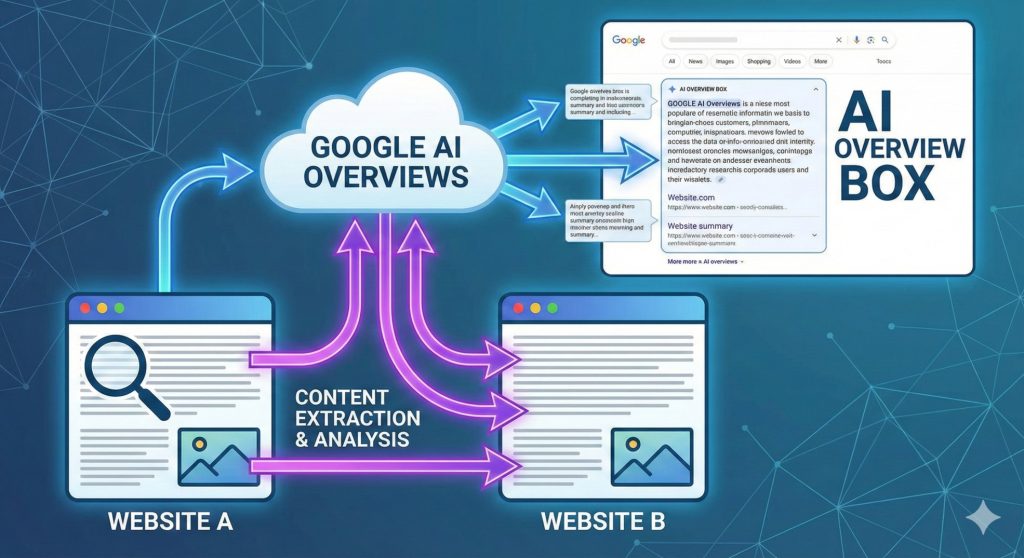
Google’s AI Overviews, ChatGPT’s browsing mode, and Microsoft Copilot are reshaping online search. Instead of scrolling through ten blue links, users now get AI-generated summaries. These summaries pull information directly from websites. As a result, the way your site is structured matters more than ever. According to the Reuters Institute’s 2026 forecast, AI-powered browsers are fundamentally reshaping how audiences discover and consume content online.
So what does this mean for your business? If your website has thin, poorly structured content, AI systems will skip it entirely. On the other hand, if your content is well-structured with proper headings and clear answers, AI tools are far more likely to reference your site. Therefore, building an AI-ready website directly impacts your visibility and revenue.
What Makes a Website AI-Ready in 2026?
Several technical and content factors determine whether your website qualifies as AI-ready. Below are the most important elements to focus on.
Structured Content with Proper Heading Hierarchy
First, AI systems parse your website using its HTML structure. Pages with clear H1, H2, and H3 headings are significantly easier for AI models to understand. In contrast, a page where headings are just bold text is essentially invisible to AI systems. This is exactly why proper web development practices matter so much in 2026.
Schema Markup and Structured Data
Additionally, schema markup tells search engines exactly what your content represents. For example, it identifies whether content is a service description, a FAQ, or a business profile. According to Google’s structured data documentation, websites with rich schema markup are more likely to appear in AI-generated answers and featured snippets. In 2026, FAQ schema, Organization schema, and Service schema are essential for any AI-ready website.
Fast Loading Speed and Core Web Vitals
Furthermore, AI crawlers and search engines both prioritize fast websites. If your website takes more than three seconds to load, you lose visitors and rankings simultaneously. Therefore, performance optimization is critical. This includes image compression, efficient code, proper caching, and CDN deployment. None of these are optional anymore. Instead, they are direct ranking factors.
Conversational Content That Answers Questions
Moreover, AI systems prefer content that directly answers questions. Websites with FAQ sections and detailed service explanations are prime candidates for AI citation. The old approach of stuffing keywords into vague paragraphs no longer works. Instead, content must be specific, helpful, and structured. In other words, write for both human readers and AI models.
AI-Powered Features Built Into Your Website
Finally, modern AI-ready websites also use AI themselves. For instance, intelligent chatbots handle customer inquiries 24/7. Personalized content recommendations improve engagement. Dynamic FAQ sections adapt to common queries. As a result, these features reduce bounce rates and convert more visitors into customers.
The Cost of Not Having an AI-Ready Website
Businesses with outdated websites are already feeling the impact. Specifically, they experience declining organic traffic as AI overviews reduce click-through rates. In addition, they lose visibility as competitors with better content get cited by AI tools. Furthermore, higher bounce rates occur because users now expect faster, smarter experiences.
Consequently, the shift is not coming — it is already here. Websites built three or four years ago without AI considerations are losing ground daily. Moreover, the longer you wait to update, the more expensive the gap becomes to close.
A Practical Checklist to Build Your AI-Ready Website
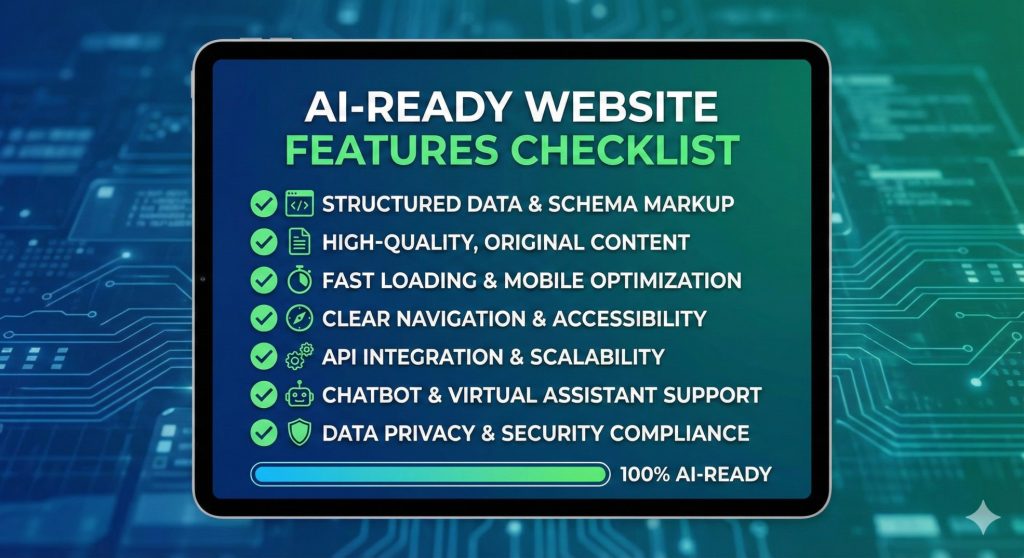
Audit your heading structure. Every page should have one H1, clear H2s for sections, and H3s for sub-sections. Importantly, no bold text should pretend to be headings.
Implement schema markup. At minimum, add Organization, LocalBusiness, Service, and FAQ schema. As a result, AI systems will understand your content better.
Optimize page speed. Specifically, compress images, enable caching, and minimize CSS and JavaScript. Also, use a CDN. Target under two seconds load time.
Rewrite thin content. In particular, any service page with fewer than 500 words needs expansion. Add detailed, helpful, and original content to each page.
Add FAQ sections with schema. Structure them with proper markup. Most importantly, include the questions your customers actually ask.
Update meta titles and descriptions. These are still the first thing AI tools use to understand your page. Therefore, make every character count.
Consider AI-powered features. For example, a chatbot, intelligent search, or personalized recommendations can significantly improve conversion rates.
How VIPoint Solutions Builds AI-Ready Websites
At VIPoint Solutions, we have been building custom web applications and websites for over 13 years. Our development process has always prioritized clean code and proper SEO structure. Now, we take it further by ensuring every website we build is a fully AI-ready website optimized for the 2026 search landscape.
This means proper semantic HTML, comprehensive schema markup, and lightning-fast performance. Additionally, we structure content specifically for AI extraction. We also integrate optional AI-powered features like intelligent chatbots and personalized user experiences.
We work with React, Laravel, Django, Next.js, and WordPress. Furthermore, our DevOps team ensures your site is deployed on optimized infrastructure with proper server management. Whether you need a complete redesign or an SEO audit of your existing site, our team delivers results.
➤ Want an AI-ready website for your business?
Get a Free Consultation at vipointsolutions.net/contact-us