
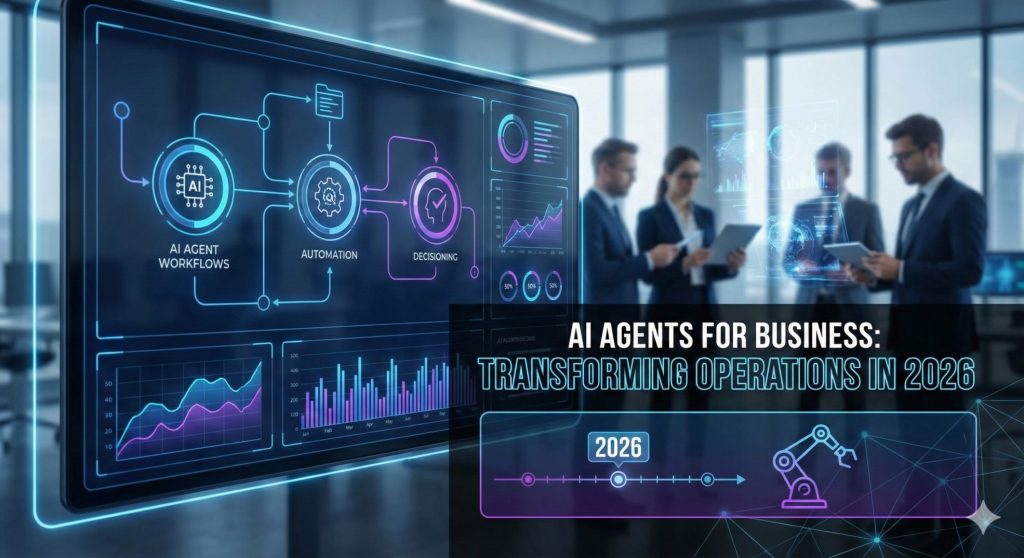
AI agents for business are the biggest technology story of 2026. If 2025 was the year companies discovered AI, this is the year AI started working for them. However, this is not about chatbots answering FAQs. It is not about a novelty feature on a landing page either.
Instead, AI agents are autonomous systems that plan, decide, and execute tasks across your business. In fact, this is the most significant technology shift since cloud computing. As a result, business owners, CTOs, and IT decision-makers cannot afford to ignore it. Simply put, the companies that adopt AI agents this year will operate faster and smarter than those that wait.
What Are AI Agents for Business and How Do They Work?
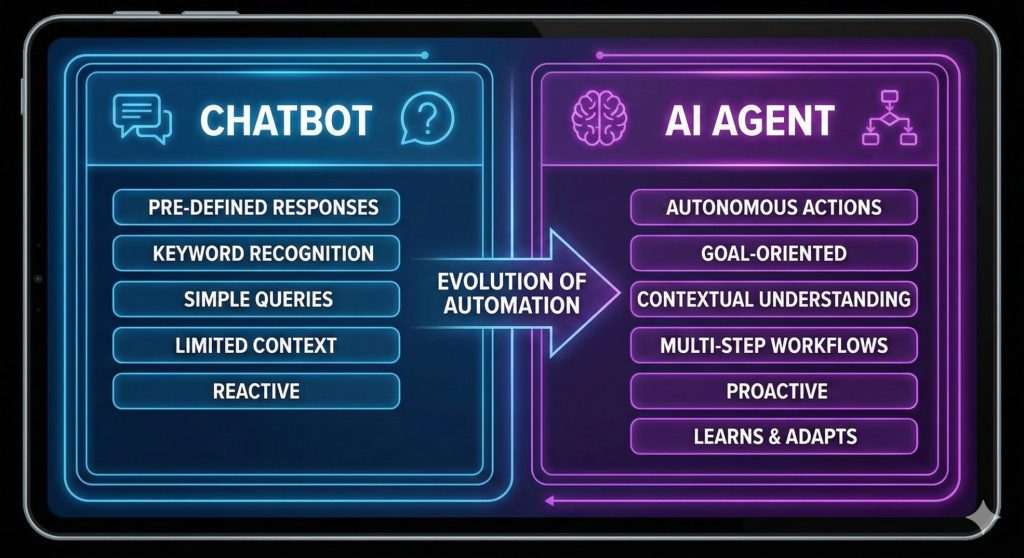
First, let us clarify what an AI agent actually is. An AI agent is not a chatbot. A chatbot waits for your question and gives an answer. In contrast, an AI agent understands your goal and breaks it into steps. It then uses tools and software to complete those steps. Finally, it delivers the result without you managing each stage.
Think of it this way. A chatbot is like a receptionist who answers your call. On the other hand, an AI agent is like a project manager. It takes your brief, coordinates the team, and hands you the finished product.
For example, an AI agent can monitor your servers around the clock. It detects a performance issue and diagnoses the root cause. Then it applies a fix and sends you a summary report. All of this happens before you wake up in the morning.
Similarly, it can process incoming support tickets automatically. It categorizes them by priority and drafts responses for simple queries. For complex issues, it escalates to your human team with full context attached.
Why 2026 Is the Tipping Point for AI Agents in Business
Several developments have converged this year. Together, they make 2026 the breakout year for AI agents for business across every industry.
First, the cost has dropped dramatically. Open-source AI models now deliver near state-of-the-art performance. As a result, businesses can run AI agents for a few thousand dollars per year. Previously, this would have cost hundreds of thousands. According to Google Cloud’s 2026 AI Agent Trends Report, businesses are already connecting agents to run entire workflows from start to finish.
Second, interoperability standards have matured. Protocols like the Model Context Protocol (MCP) and Agent-to-Agent (A2A) communication now exist. These allow AI agents from different platforms to work together. For instance, your sales agent can talk to your inventory agent. That agent then communicates with your logistics agent.
Third, enterprise trust is growing. Governance frameworks and audit trails have matured significantly. In addition, human-in-the-loop safeguards give businesses confidence. According to Gartner’s enterprise AI forecast, 40 percent of enterprise applications will include AI agents by the end of 2026.
Real-World Applications of AI Agents for Business
Customer Support and Helpdesk
AI agents now handle L1 and L2 support tickets autonomously. They resolve routine issues quickly. Furthermore, they seamlessly escalate to human agents when needed. For hosting companies and ISPs, this means 24/7 coverage. As a result, you do not need to triple your team size.
Server and Infrastructure Management
Agentic AI systems can monitor server health continuously. Moreover, they predict failures before they happen. They also auto-scale resources during traffic spikes. In addition, they apply security patches autonomously. Consequently, the traditional break-fix model is being replaced by self-healing infrastructure.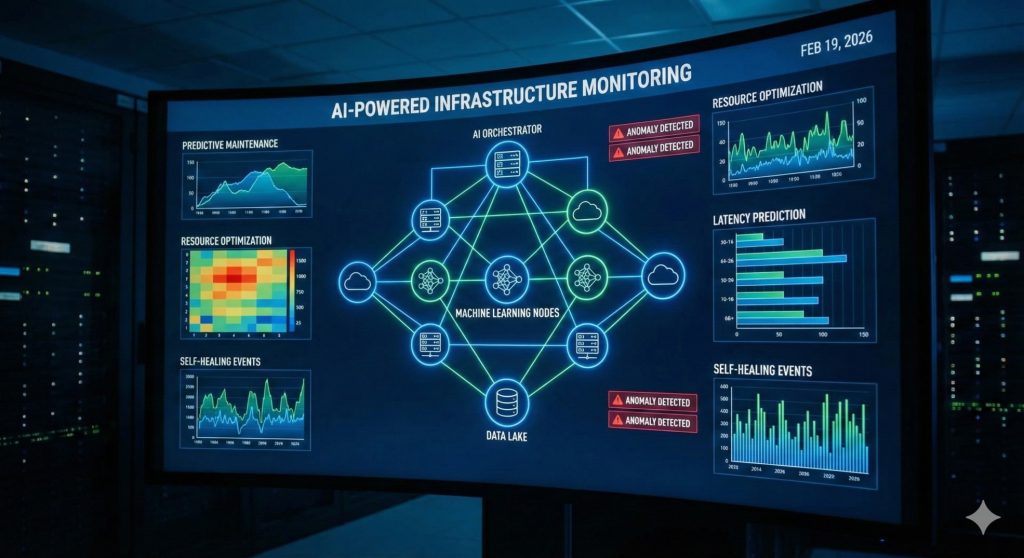
Software Development
AI agents are now writing boilerplate code and running test suites. They also perform code reviews automatically. Additionally, they deploy updates through CI/CD pipelines with minimal oversight. As a result, development teams focus on architecture and complex problem-solving. Meanwhile, AI handles the repetitive 80 percent of the work.
E-Commerce and Sales
AI agents run entire segments of e-commerce operations today. For example, they handle personalized product recommendations. They also manage inventory and dynamic pricing automatically. Notably, Danfoss, a global manufacturer, reported impressive results with AI agents. According to PwC’s 2026 AI Predictions report, enterprises with focused AI strategies see measurable ROI within their first quarter of deployment.
How to Start Using AI Agents for Business Growth
You do not need to overhaul your entire tech stack. Instead, the smartest approach follows a proven pattern.
Identify one high-volume, repetitive workflow where errors or delays are costly. For example, customer ticket triage or server monitoring alerts work well. Invoice processing is another excellent starting point.
Start with a single agent, not a fleet. Deploy one AI agent for one specific task. Then measure its accuracy, speed, and cost savings over 30 days. This gives you concrete data to evaluate.
Keep humans in the loop. The best deployments use human oversight for quality control. Specifically, humans handle exception cases and strategic decisions. In other words, full automation is not always the goal.
Scale based on results, not hype. Once your first agent proves its value, expand gradually. Build your AI agent ecosystem one proven use case at a time. This approach minimizes risk and maximizes returns.
Why AI Agents for Business Matter More Than Ever
The companies that move on AI agents this year will gain a major advantage. They will not just save money. Instead, they will operate at a fundamentally different speed.
In particular, IT operations, customer service, and supply chain benefit the most. On the other hand, companies that wait will face tough competition. Their competitors will run 24/7 with AI-powered operations. That means faster response times, fewer errors, and lower costs. Ultimately, this translates to better customer experiences.
How VIPoint Solutions Builds AI Agents for Business
At VIPoint Solutions, we have been building intelligent automation for over 13 years. Our team develops custom AI agents for business tailored to your specific workflows. For example, we automate helpdesk operations and build intelligent server monitoring systems. Additionally, we integrate AI-powered chatbots into customer-facing platforms.
Importantly, we do not sell off-the-shelf tools. Instead, we build custom AI and machine learning solutions that fit your business. Our solutions integrate with your existing systems. Above all, they deliver measurable results.
➤ Ready to explore AI agents for your business?
Get a Free Consultation at vipointsolutions.net/contact-us